Irish Coinage
____________________
Hiberno-Norse coinage
The Hiberno-Norse Coinage of Ireland, ~995 to ~1150
Index:
On This Page:
© 2020 - Copyright
John
_
Stafford-Langan
Version 1.19
3rd May, 2020
Introduction to the Hiberno-Norse coinage of Ireland
The first locally produced Irish coinage was the so-called Hiberno-Norse coinage which was first minted in Dublin in about 995-7 AD under the authority of Sithric III (aka Sithric Silkbeard), the Norse king of Dublin.
The early Hiberno-Norse coins were good copies of the English pennies of the period (typically of Aethelred II 979-1016 AD).
It is worth noting that copying the coins of Aethelred was not an attempt at forgery - the coins of Aethelred were widely recognised in North West Europe at the time. Sithric's moneyers used these designs to ensure their coins were similarly recognised. But the coins were properly signed as coming from Dublin under Sithric's authority.
After the battle of Clontarf in 1014 Ireland became more isolated from the rest of the regional community and there was a reduced requirement for money as it was the Norse settlers who were the principle traders and made most use of coined money.
The Hiberno-Norse coinage quickly degraded to crude copies of the 'long cross' type of Aethelred and by about 1030 AD they contain minimal legends of vertical strokes instead of letters.
During the following 100 years the coins became increasingly crude though for the most part still recognisably inheriting their design from the 'long cross' coinage. By the early 1100s the coins were either double or single sided bracteates (thin coins where the design on one side appears in reverse on the other).
It is difficult to see how the later Hiberno-Norse coins could have really been used as coins given how thin and brittle they are - so it is reasonable to suppose that as the coinage degraded its use became increasingly limited.
Sometime before the Normans arrival in Ireland in 1169/70 production had ceased - probably by about 1130-1150.
From a numismatic point of view the coinage is divided into 7 phases. These phases are chronological and are based on the style of the coinage.
Some of the phases and some individual coin types can be dated quite accurately, but most of the coinage can only be dated aproximately.
The date range and confidence in the dating becomes poorer as the coinage progresses. Individual first phase coins can usually be dated with some confidence to a six year production period - whereas the final sevent pahes coins can only be loosely dated to an aproximate twenty year period.
Phase I - Contemporary Copies of English Anglo Saxon Pennies
The earliest coinage of Ireland comprises an issue of silver pennies under the authority of Sithric III (aka Sithric Silkbeard) king of Dublin. These pennies follow the style of the contemporary pennies of Aethelred II of England. The Irish coins are made of good silver and are usually signed in Sithric's name and by a Dublin Moneyer so this is not an attempt at forgery but instead it is a pragmatic approach to produce coins with designs that would be widely acceptable.
Aethelred's English coinage consisted almost exclusively of silver pennies struck in as many as 97 borough mints in Anglo Saxon England. As a means of controlling the activities of the mints the policy was to change the design of the coinage every six years.
The Irish mint began its operation sometime during the CRUX issue of Aethelred.
The CRUX issue
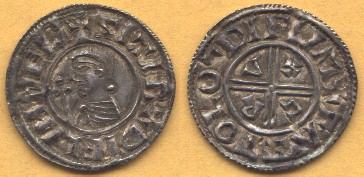
The CRUX issue was produce in England between about 996 and 1001 AD. The Irish mint began operation during this period - probably about 997 AD. The coins were issued in Sithric's name and signed by several Dublin Moneyers. Coins also occur with Aethelred signatures on the obverse but with Dublin moneyers on the reverse and similarly with English moneyers coupled with Sithric obverses.
The fourth possibility which is an Irish coin but with both sides containing directly copied 'English' signatures is possible, but such coins would be difficult to distinguish from 'real' English pennies. (They could be identified by several means, but the problem is that unless they are found in a context which suggests that they are Irish they would be identified as English and would not get the scrutiny they need to be identified as Irish).
The Irish CRUX pennies are well struck on large flans and usually occur in Very Fine or better condition. They coins are quite scarce and as they are generally considered to be the first coins struck in Ireland the are quite sough after.
The CRUX pennies were also copied widely in Scandinavia and many examples which previously considered to be Irish are now ascribed to Scandinavian production. There was a considerable trade between Ireland and Scandinavia at the time and many Irish coins have occurred in Scandinavian hoards as indeed have Scandinavian examples occurred in Irish finds.
The Long Cross Issue
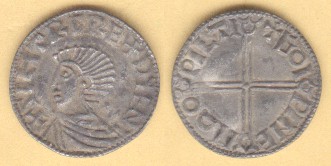
Hiberno Norse Phase I Penny - Long Cross
The next issue of Aethelred following the CRUX issue was the 'Long Cross' issue. The Irish mint probably adopted the new design within a few months of its appearing in England. The English issue was issued between 1002 AD and 1008 AD - the Irish mint was probably active for most of this period and produced more coins of this type than any other Phase I issue.
The are more Irish moneyers involved in the issue and there is a similar series of coins with either 'English' signatures or 'English' moneyers to the CRUX issue.
Long Cross Phase I Hiberno Norse coins are scarce but Generally more available than any other Phase I coins. They also occur in generally better condition than later issues.
The Long Cross coinage was even more widely copied in Scandinavia and elsewhere so many blundered versions exist. The design was used in many areas even after Aethelred's death in 1016 AD - the next two phases of Irish Hiberno Norse coinage revert to this design instead of continuing the practice of copying the contemporary English designs. (see Phase II and III )
THYMN and OGSEN
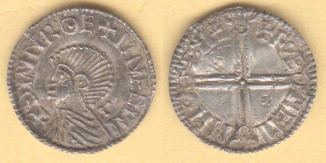
Hiberno Norse - Phase I - Long Cross - Thymn
It is during the Long Cross issue that two unusual Phase I Hiberno Norse Coins occur. These coins are struck from well executed dies and have characteristics similar to those of the Long Cross issue of Sithric except that they are issued in the names of Thymn and Ogsen. The issuers are unknown to history other than from their coins. There has been some speculation about their origin and in the cased of the Thymn coins speculation that they were struck outside Dublin. Thymn's coins are rare, Ogsen's are extremely rare.
The Helmet Issue
The helmet issue of Aethelred followed his Long Cross issue - In Dublin these coins were also copied in Sithric's name, but the issue was probably much smaller as the coins are extremely rare.

The Small Cross Issue
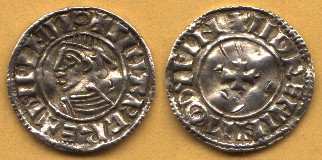
Hiberno Norse - Phase I - Small Cross
Aethelred's final issue of pennies was of the small cross type - in England this type was a reversion to an earlier type which can give rise to some confusion in the English series, but the Hiberno Norse issue clearly did not begin until the Crux issue so the Hiberno Norse small cross coins can be ascribed to the period of Aethelred's last small cross issue. These coins are also scarcer than the Long Cross Type indicating that the minting operations in Dublin were in decline.
The Quatrefoil Issue (Cnut)
Aethelred II died in 1016 AD and was succeeded by Cnut (son of Sven Forkbeard King of Denmark). Cnut's first issue of coins featured a quatrefoil on both sides. The Dublin mint was operating early in this issue and still copying the contemporary English style, but the oins in imitation of this type are even scarcer than those of Aethelred's Helmet type. The succeeding issue of Cnut (Helmet type) is not represented by any surviving Hiberno Norse Coins and it is likely that the quatrefoil issue saw the end of this first phase of Hiberno Norse coins in about 1018 AD. (JSL - The recently discovered Anlaf coin makes this statement untrue - see below).
The Pointed Helmet Issue (Cnut)
Sitric III died in 1029 and was succeeded by his son Anlaf Sithricsson.
There is a recently discovered coin of very good quality that is in the style of Cnut's Pointed Helmet issue that carries the name Anlaf and does appear to be a late phase I coin. There are a couple of problems with this coin, specifically that it is very late given no surviving pieces of Cnut's other types in Sithric's name and that it appears to clash with the generally accepted dates for the second phase of this coinage. So this coin seems to suggest that there was a fairly significant gap between the Phase I issue and the Phase II issue. Presumably there is a possibility of other Cnut styles being discovered with Sithric's name (or even further pieces with Anlaf's name). There has been a suggestion (from the late Mark Blackburn) that some of the Hiberno Norse coins of the later types were made in Anglo Saxon mints for the Dublin authorities and that would be potentially a way of explaining how the later Phase I pieces are from such well executed dies. It may even be that the Anlaf piece is from some very small 'prestige' issue which was executed (perhaps in Chester) while the normal output of the Dublin mint was in Phase II and in the now deceased Sithric's name.

Phase II - Later Long Cross Penny Imitations
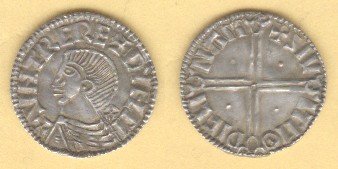
A Hiberno Norse Penny - Early Phase II
Following the end of minting of coins in direct imitation of the contemporary English issue - the mint in Dublin appears to have reverted to minting coins in imitation of the Long Cross issue of Aethelred II in about 1020AD.
The Long Cross type was originally issue between about 1002 and 1008 AD. However this type appears to have been particularly popular and perhaps because of a change in the prevailing patterns of trade following the battle of Clontarf (1014 AD) or for other reasons the mint in Dublin found it more useful to produce coins of this older style than to continue following the frequent changes in the English coinage.
This second phase of Hiberno Norse coins and the following one comprise coins which are basically of the Long Cross type. The early phase two coins have a pellet in each quarter of the reverse and are well executed coins with good legible legends. The issue gradually degrades and the legends become less intelligible and the quality of the silver is clearly reduced. The final coins of the second phase have legends which are made up of symbols which have only the appearance of lettering and often contain additional symbols. The symbol of the human hand appears on some later coins.
Phase III - Long Cross and Hands issues
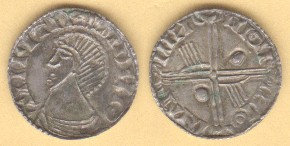
Hiberno Norse Phase III - hands and pellets
By about 1035 AD the coinage minted in Dublin had degraded to a point where it is likely that it was only being produced for internal use within Ireland as it had fallen below the standards used in any neighbouring regions. The coins are smaller and of poorer silver, they have legends made up of strokes and symbols rather than lettering, the symbol of the human hand appears on many coins in one or more commonly two quarters of the reverse cross.
The native Irish had no culture of coinage and their experience with the brief earlier issues was clearly insufficient to enable them to continue minting to a high standard following the transfer of power from the Dublin Vikings to the native Irish chieftains and High Kings.
This phase of Hiberno Norse coinage continued until about 1060 AD.
More recent discoveries have suggested that what Micheal Dolley describes as Phase III is probably two distinct phases. There is a clear division between the, probably early, coins with just the two hands on the reverse and the small neat bust style and the, probably later, coins with the taller bust style (as illustrated above) which usually carry additional reverse symbols the most common being the S shaped 'buckle' in one quarter.
Phase IV - Scratched Die Issues
Image Available
not online yet
The so called 'scratched die' coins of PhaseIV comprise a small group that could have been included with the following phase. The coins exhibit one common characteristic in that they have a cross apparently scratched into one quarter of the reverse die. The two basic designs are derived from the long cross type of Aethelred and from an as yet untraced facing bust type.
The long cross type is generally of less interest as its design coincides with late phase III and many Phase V coins - but it is a distinct type. The facing bust type is unique to this phase and attracts more interest as a distinct obverse type.
Phase V - Crude Imitative Issues
Images Available
not online yetThe fifth phase of Hiberno-Norse coins is really a bit of a kludge. It is a dumping ground for an extensive series of pennies which vary widely in design and which by their general style, production quality and weight appear to have been produced in a period of aproximately 40 years between 1060 and 1100 AD.
The designs in general are derived from contemporary or earlier English penny designs, with a significant influence from the recurring long cross / radiate bust of Aethelred II (which originally dates from about 1000 AD).
The range of designs is so wide that many of these coins are unique - though there are some common dies and designs which tend to help group the coins together.
Phase VI - Degraded Long Cross Imitations
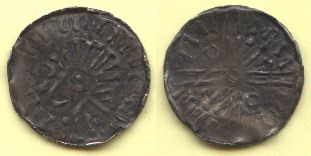
Hiberno Norse - Phase VI - anulets
By about 1100 the Hiberno-Norse coinage settled down into a period of relative stability and a large number of coins of a relatively similar design were produced. These coins had an obverse design which was a degraded form of the Aethelred radiate bust from his 'long cross' issue with the addition of a crozier design in front of the face. The reverse feature a pair of scepters in opposite quarters and the other pair of quarters usually featured a cross or a pellet, or less often an annulet (see above).
The Phase VI coins were made from a lower grade silver than the previous issues and tend to be darker than the earlier issues. There have been several hoards of these coins found and many individual finds so the tend to be less expensive than all but the phase III coins. The coins are generally unattractive with very poor striking quality and generally dark surfaces which also tends to depress the prices in the marketplace.
Phase VII - Semi Bracteates and Bracteates
|
Images Available
not online yet |
The Hiberno-Norse series died out sometime between 1130 and 1150 with a series of increasingly thin and simplistic coins.
The first group are double sided with designs derived from the ubiquitous long cross design, but they are generally so thin that the designs from each side are heavily 'ghosted' on the other side.
The second group are pure bracteates (coins struck on one side only - often with the reverse exhibiting the same design in incuse relief). They are on larger flans than the earlier coins and sufficiently thin that the incuse design is quite clear on the reverse as well.
These final coins in the series are all quite scarce and somewhat like the phase V coins there is a wide variety of designs many of represented by a single surviving specimen.
Some recent work has suggested that this final phase of coins may have continued until the Norman invasion in 1169/70.
Bibliography of Hiberno-Norse Coins
Roth, B. "The Coins of the Danish Kings of Ireland" - BNJ VI, 1909
O'Sullivan, W. "The Earliest Irish Coinage" - JRSAI LXXIX, 1949
Dolley, M.
"The Hiberno-Norse Coins in the British Museum"
- SCBI 8, 1966